
The Emotional Intelligence of Farm Animals — What Science Tells Us About Pigs, Goats, Cows & Chickens
Are cows or pigs smarter? Are chickens smarter than cows? The honest answer is that each species has been tested on different tasks — and each does something the others cannot. Here is what the behavioural research actually shows.
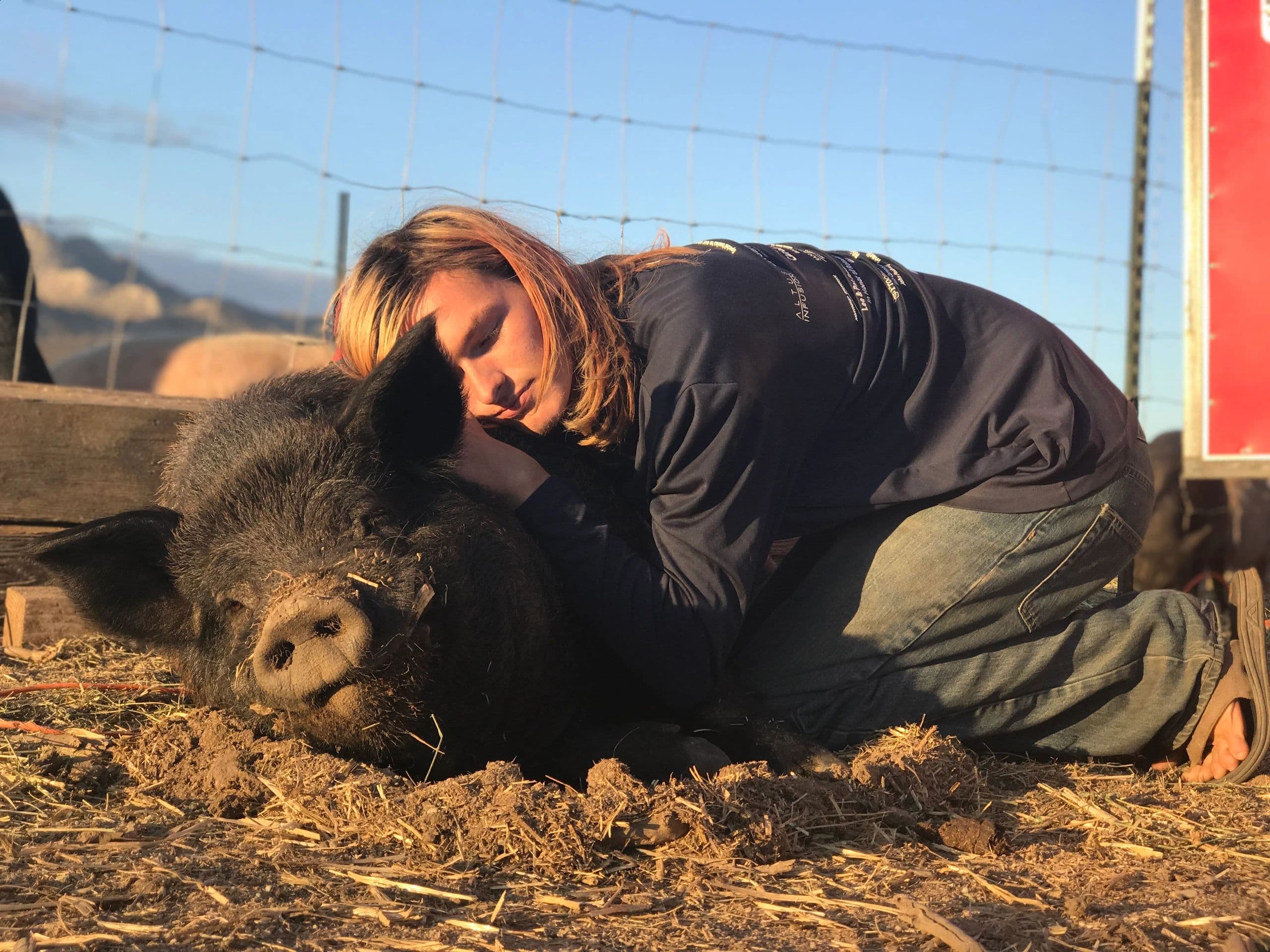
Ask which farm animal is smartest and the research answers with a question of its own: smart at what? Pigs, goats, cows and chickens have each been tested on tasks built around the lives they actually lead, and each one does something the others have never been shown to do. No study has ranked them against one another on a single scale, because no such scale exists.
So the honest short answer to every "is X smarter than Y" question is this: the two species in the question have almost certainly never been tested against each other, and the things each is good at are different in kind. What the research does establish, consistently and across every one of these species, is that farm animals have richer emotional and cognitive lives than the systems built around them assume. Below is what has actually been measured, question by question.
Are Cows or Pigs Smarter?
Pigs, on the evidence available — but the evidence is lopsided, and that matters more than the answer.
Pig cognition has been studied far more intensively than cow cognition. Pigs have been tested on spatial memory, object discrimination, social learning and operant tasks at a screen, and they perform at levels researchers routinely compare to dogs and young primates. Cows have mostly been studied for social behaviour, stress physiology and emotion rather than for problem-solving, so the two species have rarely been put side by side on the same task at all.
The most-cited result in pig cognition is mirror-related, and it is also the most commonly overstated. Broom, Sena and Moynihan's 2009 study in Animal Behaviour found that after about five hours of mirror exposure, seven of eight pigs used a mirror reflection to find a food bowl hidden behind a barrier, reaching it in a mean of 23 seconds by moving away from the image and around the obstacle. That is mirror use — interpreting reflected information about the world. It is not mirror self-recognition in the strict sense, and welfare scientists are careful about the distinction even though the finding stands on its own. You will see this study quoted as proof that pigs "recognise themselves in mirrors." It does not show that.
"Pigs are smarter than cows" is the popular answer. "We have tested them on different things" is the accurate one. Our deeper look at the pig cognition literature covers the problem-solving, memory and social-recognition work in detail, including where the research groups disagree.
Are Pigs or Cows Smarter at Social Relationships?
Here the ordering flips, or at least stops being obvious. Cows maintain specific, stable relationships with specific other cows, and the effect is measurable in their bodies, not just their behaviour.
Krista McLennan's 2013 doctoral research at the University of Northampton penned cows for short intervals either with a preferred partner or with a familiar animal that was not a preferred partner. With a preferred partner, the cows' heart rate and behavioural stress response were both lower. Notably, cortisol was not — which is the kind of partial result that gets rounded off in popular retellings and should not be. The honest version is that cows' stress responses are measurably buffered by the presence of a particular companion, and that this is one of the better-evidenced findings in cattle welfare science.
Pigs also track individuals and maintain preferences across separations. Neither species has been shown to be the better social reasoner; both have been shown to be doing something more specific than herd instinct.
Are Chickens Smarter Than Cows?
They are smarter at different things, and the chicken results are the more surprising of the two because expectations start so low.
The striking work on chickens concerns number. Rugani, Vallortigara, Priftis and Regolin, publishing in Science in 2015, found that newborn chicks familiarised with a target quantity spontaneously associated smaller quantities with the left side of space and larger quantities with the right — the same left-to-right number mapping long assumed to be a product of human culture and literacy. The finding is genuinely contested; it drew published commentary in Science and a later reanalysis, and the debate is about whether the effect reflects number mapping or something simpler. It is worth citing with that caveat attached, because the caveat is part of the science.
What is not contested is that chickens discriminate individual faces, both chicken and human, and that their vocal repertoire carries distinct, situation-specific meaning rather than undifferentiated alarm. Cows have no comparable numerical literature — not because they failed such tests, but because nobody has run them.
Are Goats Smarter Than Pigs?
Pigs, on the problem-solving tasks both have faced. But goats own a result pigs do not.
Nawroth, Albuquerque, Savalli, Single and McElligott, in Royal Society Open Science in 2018, showed goats pairs of photographs of the same unfamiliar human face, one happy and one angry. The goats preferentially approached and explored the happy faces with their snouts, and the effect was strongest when the positive image sat on the right of the test arena — a hemispheric asymmetry that suggests the processing is genuinely emotional rather than a preference for the brighter picture. The work was carried out at a goat sanctuary in Kent, on animals that were not selected for tractability.
Goats read human emotional expression. That is a social-cognitive capacity, and it sits alongside the more predictable goat findings — obstacle problem-solving, durable memory for a learned task, recognition of familiar humans.
Do Cows Have Emotional Intelligence?
Yes, in the specific and limited sense the phrase can be tested.
Cows form preferred partnerships, show measurably reduced stress in the presence of those partners (the McLennan result above), respond differently to familiar and unfamiliar herd members, and learn from watching one another. Their emotional states are readable in posture, ear position and the whites of the eyes well enough that those measures are used as welfare indicators in the field.
What the research cannot tell you is what any of that feels like from the inside. "Emotional intelligence" in the human sense implies reflective awareness of one's own and others' states, and no study has established that in cattle. What has been established is that cows have emotional states, that those states are influenced by which other specific animal is standing next to them, and that the effect is large enough to show up in a heart rate.
Why "Which Is Smarter" Is Usually the Wrong Question
Every comparison above ran into the same wall: the species were tested on different tasks, by different research groups, for different reasons. A fair ranking would require tasks that neither species was built for, which is a strange thing to ask of either.
The comparison is also doing quiet work that is worth noticing. Ranking animals by intelligence implies that how we treat them should follow the ranking — that being cleverer earns better treatment. Whether cognitive capacity ought to determine moral treatment is a real and contested question, and it is one we walk through without picking a side in Why Do We Eat Some Animals But Not Others?.
What the research has foreclosed is the older position: that farmed animals are simply not the kind of thing that has an inner life worth considering. That position is no longer scientifically tenable for any species on this page.
Meet One of Them
Everything above is a literature review, which is a strange way to meet an animal. The alternative is to meet a specific one.
Smokey is a Jerusalem donkey in his twenties who was surrendered because he was alone and sad on the property where he lived. He is exceptionally tolerant of affection, openly jealous when his best friend Buckwheat gets attention instead, and slow and deliberate about nearly everything. None of that comes from a study. It comes from living with him.
If the research above changed anything for you, sponsoring a resident is the direct version of that — it funds the daily care of one named animal, and you find out who they turn out to be.