
Are Pigs Intelligent? What the Research Actually Says
The cognition research on pigs is wider and deeper than most readers expect. This page is a tour of what the science actually shows — and what it doesn’t — written for curious readers and grounded in the labs doing the work.
The Short Answer
Yes, dramatically — and the better question is “smart how.” Pigs perform well across most cognitive measures that have been adapted from primate and canine research: spatial memory, object discrimination, social learning, tool-adjacent problem-solving, and at least one form of self-recognition. That breadth is interesting on its own. What makes it more interesting is that pig intelligence is specifically pig-shaped — it solves the problems a pig is built to solve, in the ways a pig is built to solve them. The cognitive style is not a smaller version of a human or a dog.
The literature comes from a handful of research groups — Edinburgh’s Animal Behaviour and Cognition group, the Croney Research Group at Purdue, welfare-science teams at Bristol led by Suzanne Held, and Kristina Horback’s lab at UC Davis. Their work overlaps and disagrees in productive ways. What follows is a tour of the strongest findings and what they imply.
Problem-Solving and Learning
The most-cited finding in pig cognition is mirror-related.
Mirror Use vs. Self-Recognition
Broom, Sena, and Moynihan’s 2009 study in Animal Behaviour (DOI 10.1016/j.anbehav.2009.07.027) reported that after only five hours of mirror exposure, seven out of eight pigs successfully used a mirror reflection to locate a food bowl hidden behind a barrier — reaching it in a mean of 23 seconds by moving away from the image and around the obstacle. The result placed pigs in a small set of non-human species (great apes, dolphins, magpies, elephants) shown to interpret mirror information. Current welfare scientists describe this as mirror use rather than full mirror self-recognition in the strict primate sense (the hedge matters; the finding still does).
Operant Learning: Joystick and Touchscreen Tasks
Pigs also do well on touchscreen and joystick tasks. The Croney lab at Purdue extended earlier joystick work showing that pigs can learn to move a cursor toward on-screen targets and acquire new shape-matching rules across sessions — a level of operant learning comparable in shape, if not speed, to what dogs and some primates produce in the same paradigms. The finding people usually want to hear here is “pigs are smarter than dogs.” The honest answer is that cross-species intelligence comparisons are not what the research is designed to do; both species do well on tasks adapted to their ecologies, and a fair comparison would require tasks neither species was selected for. The comparison sells; the comparison also obscures.
Spatial Memory and Observational Learning
Memory and spatial cognition are well-documented. Pigs navigate foraging environments by remembering food-source locations and the time elapsed since they were last visited — a pattern Edinburgh’s cognition group has described in detail. They also learn from watching one another: a pig that has seen another pig solve a feeder problem solves it faster on first attempt than a pig that has not. This is standard observational learning — acquiring new behavior by watching a conspecific, the same capacity documented in corvids and dogs.
How Intelligence Shows Up in Daily Care
The most practical implication of the cognition research is that pigs need cognitive load the way other domestic animals need exercise. A pig with nothing to think about generates its own work, usually at the expense of fencing, infrastructure, or a caretaker’s patience. Rooting puzzles, foraging boxes, novel arrangements of the same objects, and predictable but non-rote routines all keep behavior inside the bounds of what daily care can absorb. An under-stimulated pig is not a calm pig; it is a pig about to solve a problem you didn’t want solved.
Trainability follows from the learning research directly. Pigs respond well to positive-reinforcement protocols — clicker training, target-stick work, station behaviors — at speeds comparable to dogs once a working reinforcer is identified (food, almost always; pigs are extremely food-motivated). The same intelligence that makes them trainable makes them resistant to coercive methods: a pig who has been punished does not generalize obedience; a pig who has been reinforced consolidates the behavior and extends it.
For first-time pig caregivers, the cognition research is the same body of evidence that drives the more practical expectation-setting elsewhere on this site. The Is a Pig a Good Pet? page goes deep on the household side of that picture, and the Mini Pigs Don’t Stay Mini page covers the breed-myth side. The cognition is part of what makes pigs rewarding to live with; it is also part of what makes them demanding.
Key Takeaways
- Pigs demonstrate problem-solving, spatial memory, and learning measured in controlled studies (mirror use to locate hidden food; joystick and touchscreen operant tasks).
- They show social learning and emotional contagion — picking up information and emotional/physiological states from other pigs even without direct sight of the cause.
- Individual pigs have stable, distinguishable personalities (boldness, sociability, caution) observable in daily sanctuary care and documented across labs.
- The research spans respected, overlapping groups (Edinburgh, UC Davis, Bristol, Purdue) rather than a single contested study; findings are robust but require ecological interpretation.
- Intelligence is informative but does not by itself resolve the ethical questions — the page states this limit explicitly and points to the companion ethical pillar.
Common Questions
Quick answers drawn from the research synthesis above. For practical care, housing, and daily-life questions, see the full FAQ.
Are pigs actually intelligent?
Yes. Peer-reviewed studies from multiple labs document problem-solving, spatial memory, mirror use, joystick tasks, social learning, emotional contagion, and stable individual personalities — placing pigs among the more cognitively capable domesticated animals.
See the main FAQ for related questions on pig behavior and care.
Do pigs recognize themselves in mirrors?
They show clear mirror use (using reflections to find hidden food after brief exposure). Full mirror self-recognition in the strict primate sense remains contested; welfare scientists describe the finding as mirror information use rather than self-recognition.
Can pigs learn from watching other pigs?
Yes — observational learning is well-documented. A pig that has watched another solve a feeder problem solves it faster on first attempt than a pig that has not.
See the main FAQ for questions on pig social housing and training.
Does intelligence change how we should treat pigs?
The research rules out the old claim that farmed animals are incapable of the relevant mental states. What follows — ethical, legal, and personal choices — is a live debate with multiple defensible positions. This page presents the evidence; it does not prescribe the conclusion.
What Does the Intelligence Mean?
The research can describe what pigs can do. It does not tell anyone what to do about what pigs can do. The question of whether cognitive capacity ought to change how we eat, how we farm, how we legislate, or how we organize our institutions sits one layer above the empirical work, and that layer is contested in ways the empirical work isn’t. Some readers will arrive at this section having already decided. Some will arrive having not decided. Both are doing the reading correctly.
What the research does usefully is foreclose one position: the older view that farmed animals were simply incapable of the kinds of mental states the question requires. That position is no longer scientifically tenable for pigs. What follows from rejecting it is the live debate — and it is a debate, with multiple defensible positions, not a settled answer. The companion pillar on Why Do We Eat Some Animals But Not Others? walks through the major ethical frameworks one position at a time without picking among them. Steampunk Farms does not pick among them here either.
From the Academy
The science on pig cognition lands harder when it is presented as story rather than as data dump. The Academy's opening lesson on narrative persuasion explains why — and how to use that without being manipulative.
Every Academy lesson is free.
Meet Some Pigs at Steampunk Farms
The science covered above is general. The pigs at Steampunk Farms are specific. Their bios are short on cognition research and long on the practical details of who they are. Their names, the rough shape of their stories, and a link to each full profile are below — read by hand for the individual versions of the patterns the labs measure in aggregate.
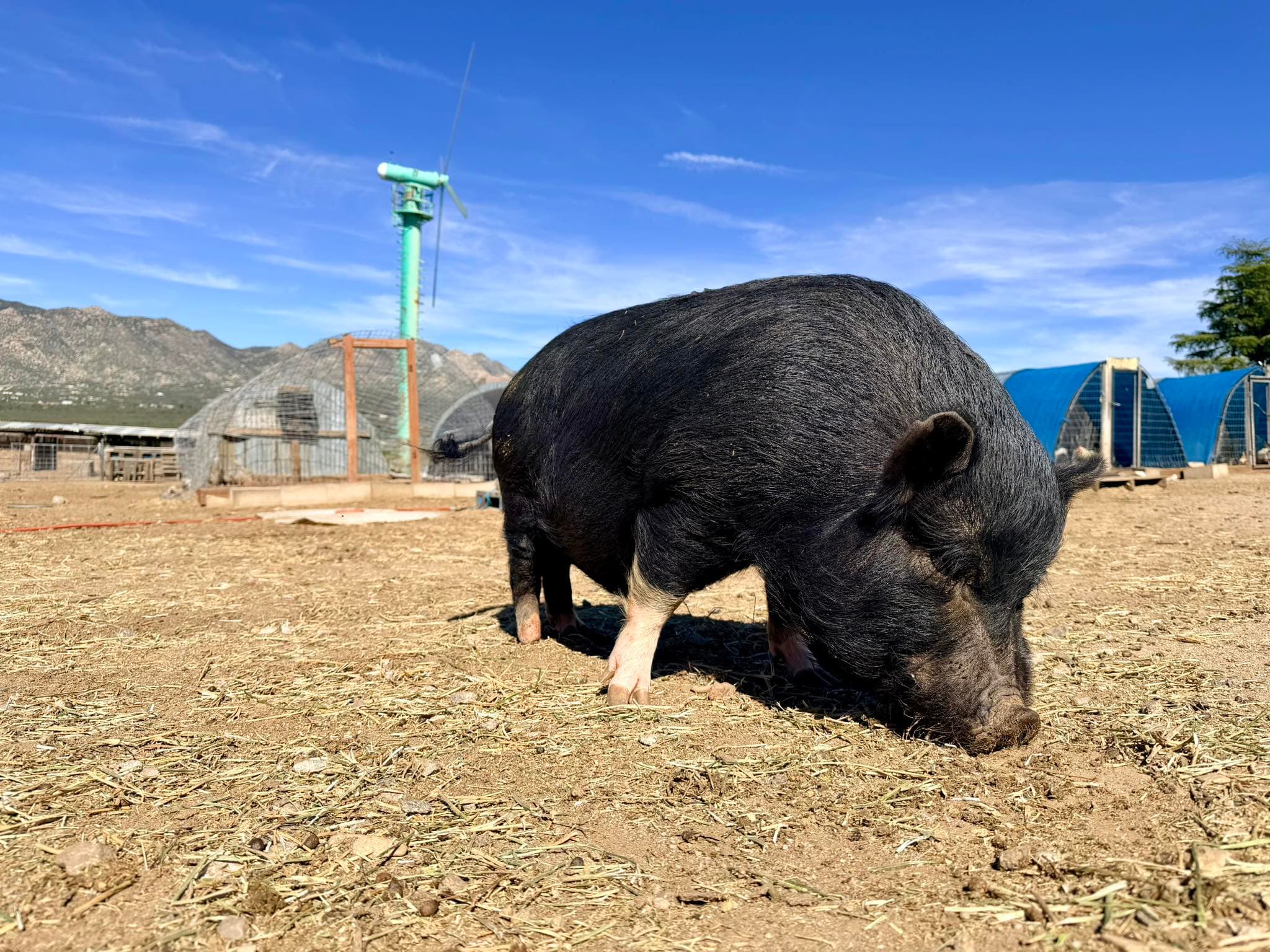
Jute — one of the specific pigs whose daily life illustrates the patterns (personality, social recognition, need for cognitive load) measured in aggregate by the labs. Jute is our charismatic pot-bellied ambassador who greets every visitor with the enthusiasm of a black and white tornado and the confidence of someone who absolutely knows he's the star of the show. This remarkable pig…
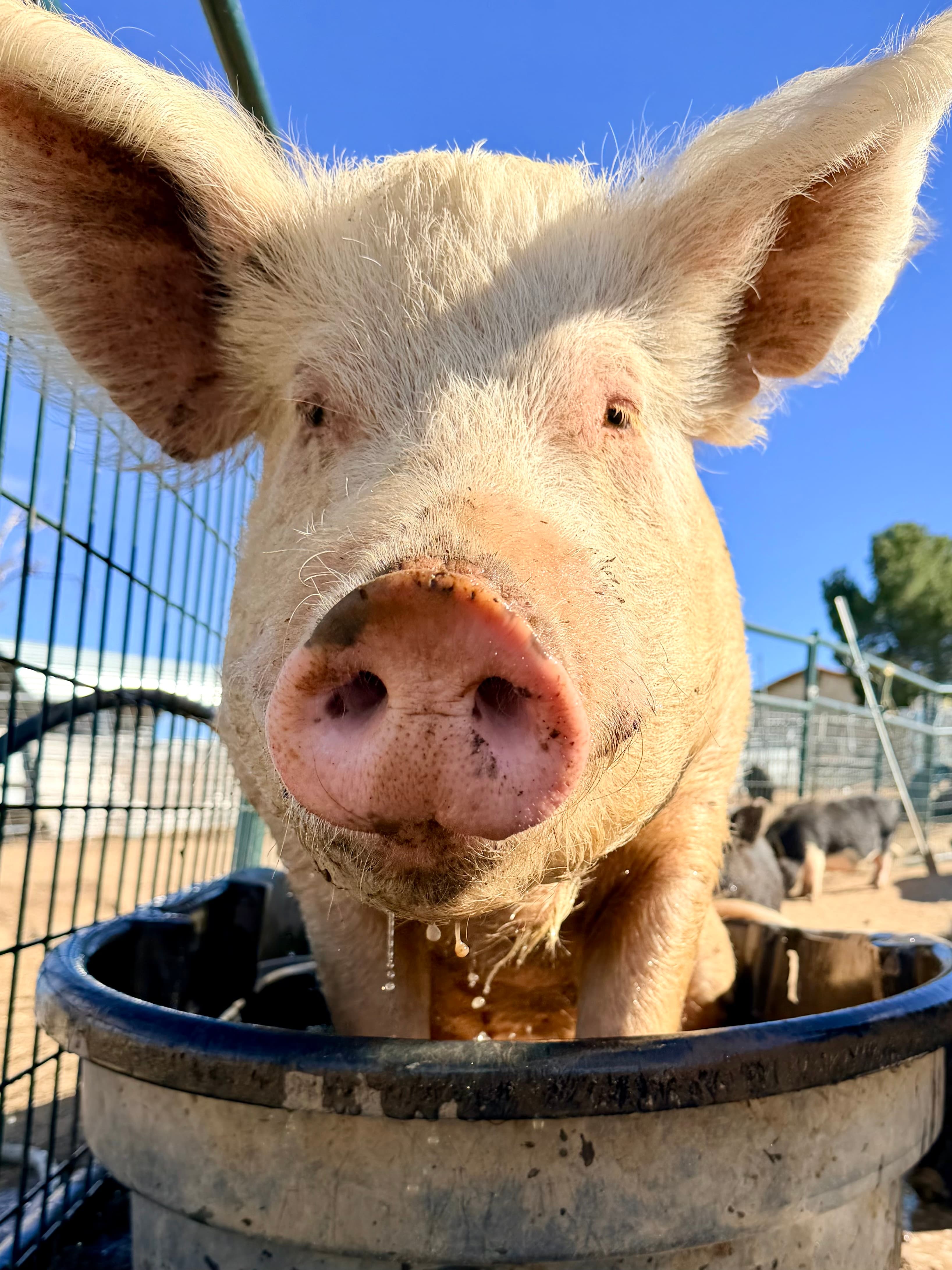
Mo Love — one of the specific pigs whose daily life illustrates the patterns (personality, social recognition, need for cognitive load) measured in aggregate by the labs. Mo Love is a magnificent force of nature who demands your full attention and isn't shy about claiming every square inch of space she deserves—including your feet, which she'll happily use as her personal recliner. This…
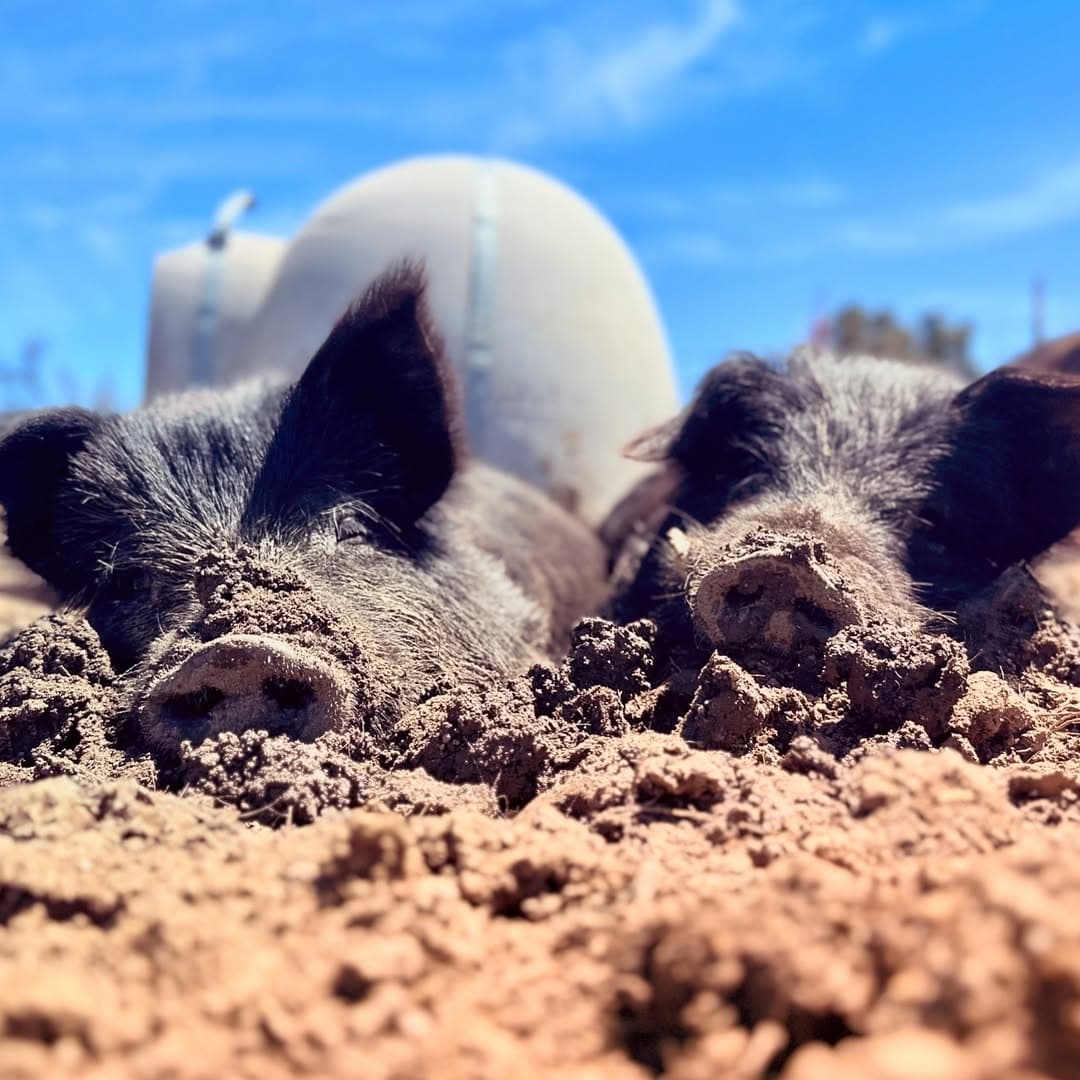
Tashi & Hiro — one of the specific pigs whose daily life illustrates the patterns (personality, social recognition, need for cognitive load) measured in aggregate by the labs. Tashi and Hiro are the ultimate sibling duo who prove that some bonds are absolutely unbreakable — despite sharing their spacious yard with 64 other pigs, these two are utterly devoted to each other and can always be…
Each lives now as a resident, not a research subject. Read their pages for the individual stories.
References
The cognition findings on this page are drawn from peer-reviewed welfare science and animal-cognition literature. Krystal’s editorial review may add or refine references over time.
- Broom, D. M., Sena, H., & Moynihan, K. L. (2009). Pigs learn what a mirror image represents and use it to obtain information. Animal Behaviour, 78(5), 1037–1041.
- Croney Research Group, Center for Animal Welfare Science (Purdue University). Operant learning and welfare research on domestic pigs.
- Edinburgh Animal Behaviour and Cognition Group (Royal (Dick) School of Veterinary Studies, University of Edinburgh). Spatial cognition and observational learning in farm animals.
- Held, S. D. E., et al. Welfare-science research on pig social cognition and emotional contagion. Bristol Veterinary School, University of Bristol.
- Horback, K. M., et al. Individual personality and social cognition in domestic pigs. UC Davis Animal Science.
- Marino, L., & Colvin, C. M. (2015). Thinking pigs: A comparative review of cognition, emotion, and personality in Sus domesticus. International Journal of Comparative Psychology, 28. (Review-style synthesis source.)