
The Hegemony of Playfulness — Why Animals Aren't Allowed to Have Fun Without a Permission Slip
An otter juggles a pebble and science calls it practice. A child does the same thing and we call it play. Joy must present its credentials — but only when the one enjoying it has paws instead of hands.
The otter rolled onto his back, because he trusts the world.
A pebble sat in his paws. He spun it once, then again, then tossed it into the air and caught it with the casual competence of someone who has done this before and intends to do it again.
He looked pleased.
Humans hate that word when it belongs to anyone else.
Through the creek's soft distortion, the stone flashed and disappeared and returned. His whiskers lifted. His eyes brightened. His body moved with the loose precision of a creature doing something for no reason except that it feels good to do.
Science has a word for this. Practice.
If a human child did the same thing, the language would change immediately. It would become creativity. Imagination. Play. Personality. Joy.
A paw makes it less of a laugh. That is the rule. Humans wrote it. Humans enforce it.
The Adjective Defense
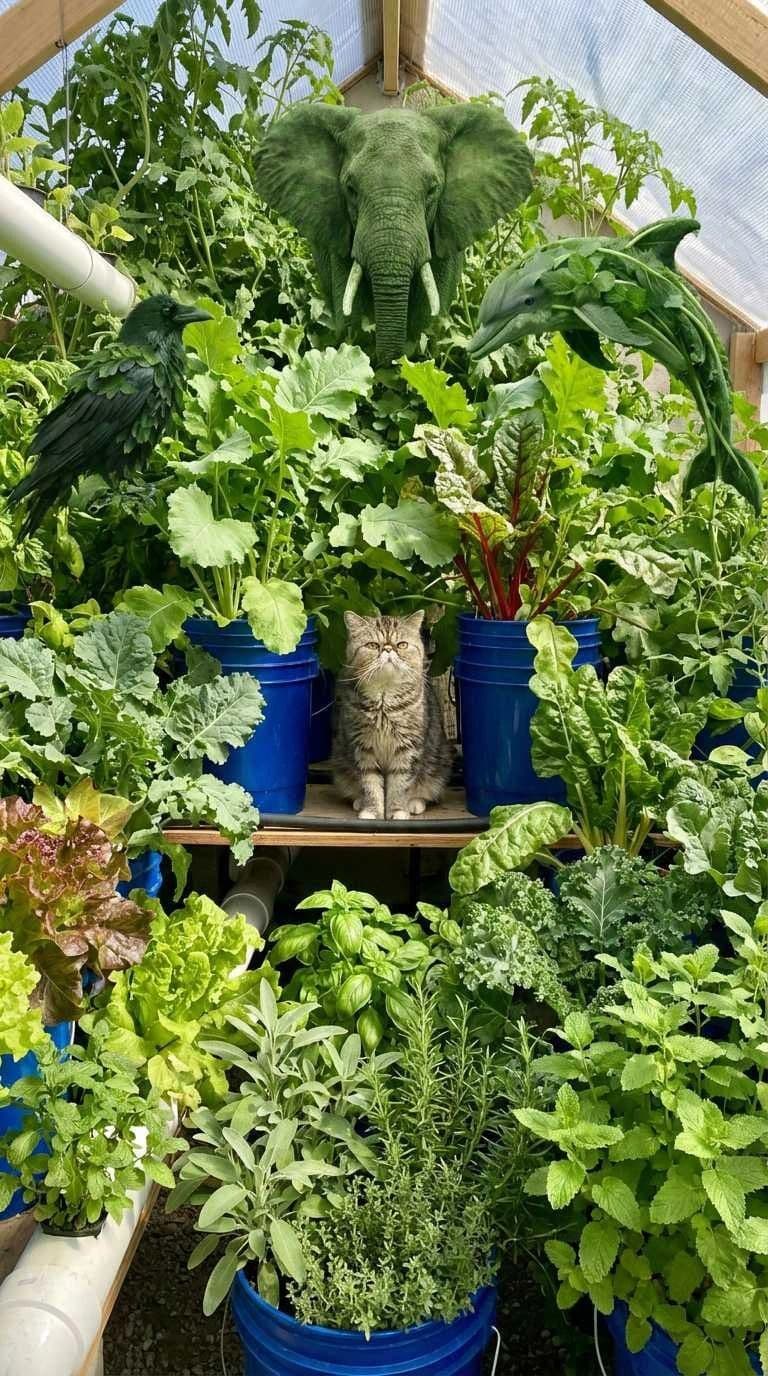
I asked Ellee about this from my usual spot near the hydroponic greens, where the lettuce towers hum quietly and the porch light warms the ledge with slow approval.
Ellee opened his one amber eye to look at the large screen we keep on his porch where we watch how "people" perceive — and showcase — their learned displays of hegemony. He did not move the rest of his face.
"Humans," his expression said, "are exceptionally skilled at protecting their hierarchy with adjectives."
He shifted his weight like a monarch rearranging a kingdom.
Ellee used to live feral. He knows what it means to be categorized into less-than. He knows how quickly a life becomes a label.
Joy Must Present Its Credentials
Humans insist animal play must justify itself. Every leap must be rehearsal. Every tumble must be training. Every game must be a tool for survival.
Otters juggle stones to refine motor skills. Ravens slide down icy roofs to improve flight agility. Dolphins ride bow waves to strengthen muscle groups or bond socially or signal intelligence.
The conclusion is always the same — animals are not allowed to enjoy themselves without permission from a utility. Joy must present its credentials.
Humans do not do this to themselves. Humans do this to everyone they want to keep beneath them.
A child slides down a hill and nobody asks what evolutionary advantage it provides. Adults take vacations and nobody forces them to submit a survival rationale before boarding a plane. Humans dance in kitchens for no reason at all, then call it living.
A raven slides down a roof repeatedly, feathers fluffed, body loose with exhilaration, and the story becomes a study. A chart. A cautious sentence with a leash on it.
Play is recognized as play only when the player is human. This is not a failure of observation. It is a decision.
The Fence Made of Language
Language reveals the decision:
"Play behavior appears to be evolutionarily advantageous." "May serve skill acquisition." "Likely contributes to social cohesion."
Those sentences are not wrong. They are incomplete on purpose. They sound objective. They function as a fence.
Rene Descartes helped build one of the older fences by describing animals as machines. Clockwork bodies. Reflex without feeling. Motion without interior.
Humans have been walking that road ever since, even while insisting they have moved beyond it.
Modern research has made the machine story hard to defend. The vocabulary adapted:
- Animals can feel, but "in a limited way."
- Animals can think, but "without abstraction."
- Animals can communicate, but "without language."
- Animals can play, but "for function."
This is how supremacy survives evidence. It changes the labels. It maintains the hierarchy.
Marc Bekoff has said plainly what many observers see — animals play because it is fun. That sentence is dangerous because it is simple. It cuts through the ritual of hedging. It treats animals as beings with an inner life, not as biological equipment running programmatic cron jobs.
Humans prefer complicated words to avoid simple moral consequences.
The Shadow and the Butterfly
I have watched Ellee bat at a butterfly's shadow. Not the butterfly. The shadow.
He was not hunting. He was not practicing. He was not preparing for war. He was enjoying the existence of a moving shape across sunlight.
If a human stared at drifting leaves and smiled, someone would call it mindfulness. If Ellee does it, the story becomes instinct. Reflex. Predation rehearsed.
Everything becomes training when you are trying to deny someone leisure.
Dolphins are harder to minimize because they are charismatic in a way humans can tolerate. Marine biologists record dolphins blowing bubble rings, balancing objects, tossing seaweed, leaping into the air with no obvious purpose except for the thrill.
Even then, the language rushes in to domesticate the truth: social bonding, skill enhancement, intelligence signaling. Useful. Functional. Acceptable.
Never simply... joy.
What Humans Fear About Joy
The question is not whether these behaviors have benefits. Many forms of play probably do. The question is why joy is treated like contraband unless it comes with paperwork.
Humans fear what follows joy. Joy suggests agency. Agency suggests full emotional lives. Full emotional lives suggest suffering — and that counts.
A culture that profits from animals needs their inner worlds to remain questionable. Uncertain. Diminished. Easier to ignore.
So the same linguistic pattern repeats:
- Animals "react," humans "feel."
- Animals "vocalize," humans "speak."
- Animals "display," humans "express."
- Animals "practice," humans "play."
Othering does not start with violence. It starts with grammar.
The Pebble
The otter tossed the pebble again. It spun in a clean arc, caught by paws that looked like hands refusing to apologize for being paws.
His eyes held mischief. Not "apparent mischief." Not "mischief-like behavior." Mischief. A familiar thing.
Humans call that familiarity "anthropomorphism" as if recognizing a shared emotional shape is a moral error. The more honest explanation is less flattering — humans dislike mirrors unless they are in control of the reflection.
Ellee yawned the way only a cat can yawn — full-body, arrogant, unhurried. He did not offer comfort. He offered clarity.
"Humans," his half-closed gaze said, "build elaborate stories to keep their supremacy intact. They fear joy uncomplicated by purpose. Unnecessary joy makes them feel replaceable."
He was right. Cats often are.
Refusing to acknowledge animal joy does not protect science. It protects an identity. It preserves the fragile narrative that humans are the only beings who create for pleasure, laugh for no reason, play for the sake of being alive.
That narrative is not only false. It is expensive. It costs animals their dignity. It costs humans their humility. It costs everyone a wider understanding of what life is.
Joy is not a human trademark. It is a living thread. It shows up wherever a nervous system has room to breathe and a world has enough safety to risk delight.
The otter spun the pebble one more time, then held it to his chest like a treasure.
No lesson. No utility. No justification.
Just a creature enjoying the feel of existence in his paws.
Humans could learn from that. Humans could stop demanding that every beautiful thing explain itself.
Humans could admit the simplest truth — other beings are not props in the human story. They have stories of their own. Some of those stories include laughter.
A paw does not make it less real. It makes the denial more obvious.