Professor Harold is in session…
Professor Harold is in session… if you can conjugate your excuses, you can conjugate your courage. Class meets in the hay aisle. — — — — — — — — — Before We Begin Before Professor Harold von Wisdom sa...
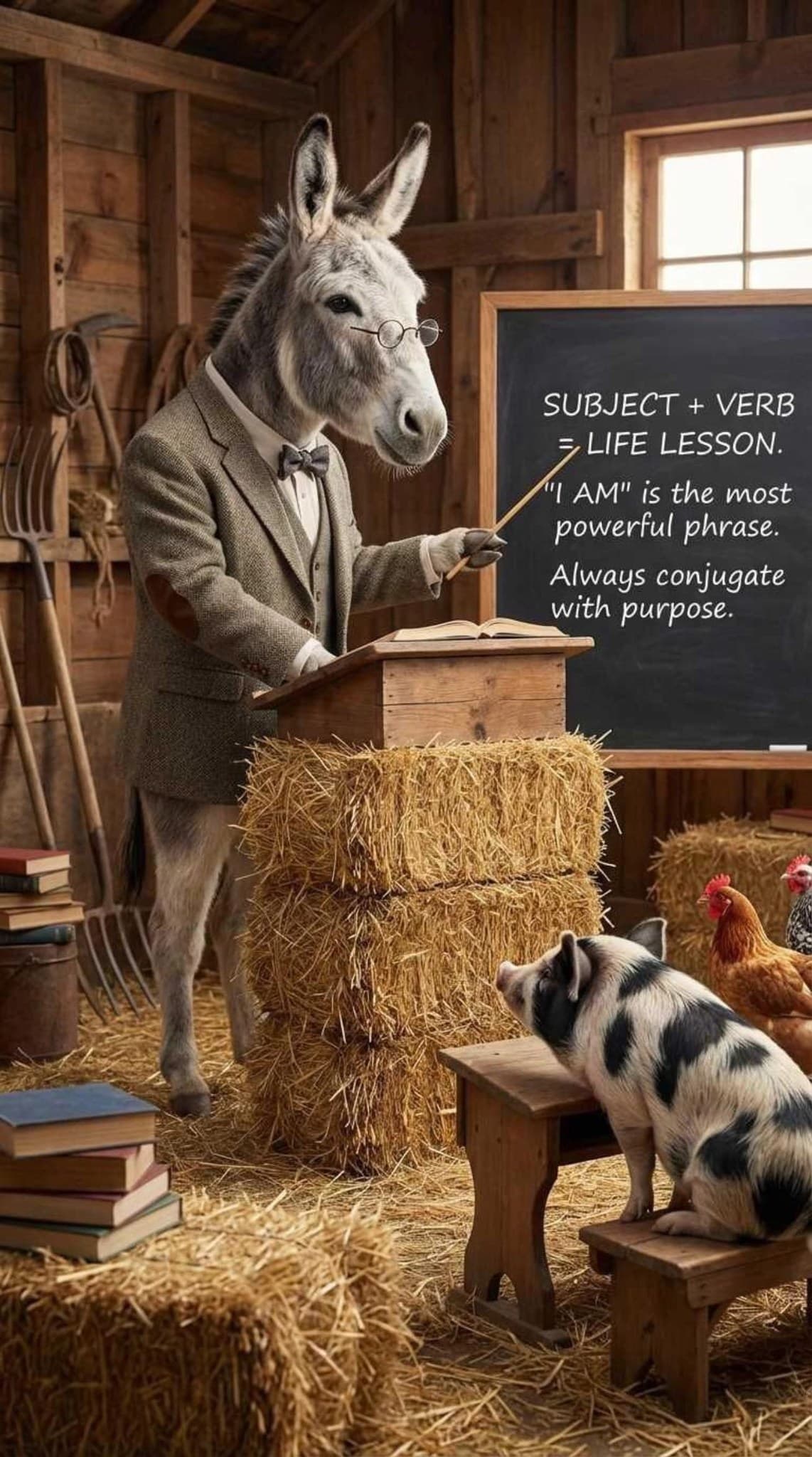
Professor Harold is in session… if you can conjugate your excuses, you can conjugate your courage. Class meets in the hay aisle.
— — — — — — — — —
Before We Begin
Before Professor Harold von Wisdom says anything at all, there is a pause.
Not an empty one. A listening one.
The meadow has learned this pause well.
It happens before lessons, before questions, before the chalk touches the board.
It is how the day makes room for what it does not yet know.
Professor Harold believes this is important.
“You already use grammar,” he tells his students. “You just do not always notice it.”
They laugh at that, because it sounds like a trick, but he is correct. Every time they listen carefully, choose their words, hesitate, connect, explain, or change their minds, they are already practicing the grammar of life.
This passage is not here to make you perfect.
It is here to make you attentive.
Professor Harold will suggest something quieter.
That punctuation does not only shape sentences... It shapes conversations. It shapes disagreements.
It shapes how we stand with one another when things are not simple.
Each mark you meet here has a small lesson to offer…not about rules, but about choices.
When to listen. When to continue. When to pause. When to connect. When to explain. When to change direction. When to add gently. When to clarify. When to wait.
These stories are not meant to hurry you.
You may read one and stop. You may read one and argue with it. You may read one and notice something about yourself that you did not expect.
All of that is allowed.
Professor Harold would only ask one thing of you before you begin…
Read as if someone else’s words matter. Because they do. So do yours.
Now… Let us begin.
— — — — — — — — —
Quotation Marks “I Hear You.”
The morning had the kind of quiet that made small sounds feel important.
A finch practiced three notes above the meadow. The chalkboard leaned against the oak as if it, too, were listening.
Professor von Wisdom stood with his hands folded. He waited until the last shuffle of paws and hooves found its place.
Penelope sat forward. Ollie tried very hard not to wag his tail against Tabitha’s notebook. Liam, as usual, was present in the careful way a moon is present—quiet, but unmistakable.
Professor Harold wrote two small marks on the board.
“ “
Quotation marks.
“They look small,” he said, “and they are. But small things often carry the most weight.”
Penelope lifted her snout. “They’re for when someone talks.”
“Yes,” Professor Harold said. “They hold words that belong to someone else.”
Ollie’s ears flicked. “So… they’re like fences?”
Professor Harold smiled, as if he’d been offered a thoughtful idea.
“Not a fence,” he said gently. “More like a porch rail. Something you hold while you step closer.”
He wrote a sentence.
Tabitha read aloud, “I don’t like being interrupted.”
Then he underlined the middle of it.
“I don’t like being interrupted.”
“Quotation marks,” he said, “do something that is easy to forget. They slow us down long enough to notice a voice that is not our own.”
Tabitha’s whiskers twitched. “But people can repeat words and still be mean about it.”
“Yes,” Professor Harold said. He did not hurry past the truth. “A voice can be borrowed roughly. Or it can be carried with care.”
He turned the chalk in his hoof.
“Let us try something.” He looked at Ollie. “Tell us something true.”
Ollie sat up straighter. “I get excited,” he said, “and sometimes I talk over everyone because I think my idea will run away if I don’t say it fast.”
Professor Harold nodded, as if Ollie had placed something fragile in the center of the room.
He turned to Tabitha. “Would you repeat what Ollie said?”
Tabitha hesitated. She did not like speaking for anyone.
But she tried.
“Ollie said, ‘I get excited, and sometimes I talk over everyone because I think my idea will run away if I don’t say it fast.’”
Ollie blinked.
Hearing his own words come back to him made them sound different… Less like a joke. More like a fact.
Professor Harold’s voice softened. “How did that feel?”
Ollie’s tail slowed. “Like… she actually listened.”
Liam’s hoof rose halfway, fell, then rose again.
Professor Harold turned to Liam. “What did you notice?”
“It sounded kinder,” he said. “Because she didn’t change it.”
Professor Harold tapped the quotation marks once. Then again.
“Exactly,” he said. “Quotation marks are not for improving someone’s words. They are for respecting them.”
Penelope raised a hoof. “But what if someone says something messy? Like… not in the right order?”
Professor Harold’s eyes warmed.
“Most honest things are messy at first,” he said. “If you want to help, you may ask. But first—you show that you heard.”
Then he told them a story.
“In a nearby meadow,” he began, “there is a pond where the geese gather. They are very sure of themselves, as geese often are.”
Ollie smiled. Tabitha did not.
“One spring,” Professor Harold continued, “a young swan arrived—alone, tired, and smaller than the geese expected a swan to be.”
“The geese had many ideas about this. Most of them were loud.”
“The swan tried to explain,” Professor Harold said, “but the geese talked over her with their own conclusions.”
He lifted the chalk and traced quotation marks in the air, like small lanterns.
“An old turtle lived at the pond’s edge. He listened until the swan finished—every uncertain word.”
Then the turtle said, very simply, “You said, ‘I am looking for water that feels safe.’”
The pond grew quiet.
“For the first time,” Professor Harold said, “everyone heard what the swan had actually said, instead of what they expected her to say.”
Tabitha’s gaze sharpened. “Did the geese stop being geese?”
Professor Harold allowed the smallest smile. “Not immediately. But they stopped being careless with their certainty.”
Penelope whispered, “What happened next?”
“The turtle asked a real question,” Professor Harold said. “Not a clever one. Not a trap.”
He wrote it on the board.
What would ‘safe’ look like for you?
“Quotation marks,” Professor Harold said, “often lead to better questions.”
He turned back to the class.
“Here is a practice.”
He wrote:
You said, “_.”
Then underneath it… Did I hear you correctly?
“Use it when things feel tangled,” he said. “Not to win. To see.”
The wind moved through the oak leaves. The chalkboard creaked softly.
Tabitha glanced at Ollie.
Ollie glanced back—suddenly solemn.
“Ollie,” Tabitha said, “you said, ‘I get excited and talk over everyone because I think my idea will run away.’”
She paused.
“Did I hear you correctly?”
Ollie swallowed. Then nodded.
“You did.”
Professor Harold set the chalk down.
“That,” he said, “is what quotation marks are for.”
He looked once more at the board— at the small marks holding a voice the way hands hold water.
Carefully. Without squeezing.
“Class dismissed.”
And the meadow, for a moment, sounded like listening.
— — — — — — — — —
Quotation marks remind us…listening carefully is one of the deepest forms of respect.
Quotation marks say… “I hear you—and your words matter.”
Quotation marks help us carry someone else’s words with care, not control.
— — — — — — — — —
You can find this story and many more on our blog The Bray @ https://steampunkfarms.org/the-bray
Keep the lantern lit at Steampunk Farms – If this story mattered to you, choose to support the animals with one or more prongs of our Giving Hayfork
Shop the Cleanpunk Shop – Handmade Ambassador Animal soaps that fund rescue care. Shop @ → https://cleanpunk.shop
Donate to Steampunk Farms – Hay, bedding, and vet care, with fee-free options on our Donate page. Donate @ → https://steampunkfarms.org/donate
Subscribe to Storytellers’ Sanctuary – Support the writing that carries our mission beyond the fence line. Subscribe @ → https://storytellers.steampunkfarms.org
One prong is enough.
Founder's Note: There are no salaries at Steampunk Farms – 100% Volunteer Driven from the Board Room to Hay Shed – Your Support Goes to the Animals o
0 notes
Support The Cluck Crew
Every dollar goes directly to feed, shelter, and veterinary care for the animals in this story.
Donate Now501(c)(3) · EIN 82-4897930 · 100% tax-deductible