
When a Bird Talks, It's "Mimicry." When We Do It, It's "Language." — The Double Standard of Animal Communication
A raven repeats a sound and we call it mimicry. A human repeats a sound and we call it language. The difference isn't in the sound — it's in the speaker. Why do we work so hard to convince ourselves animals don't communicate?
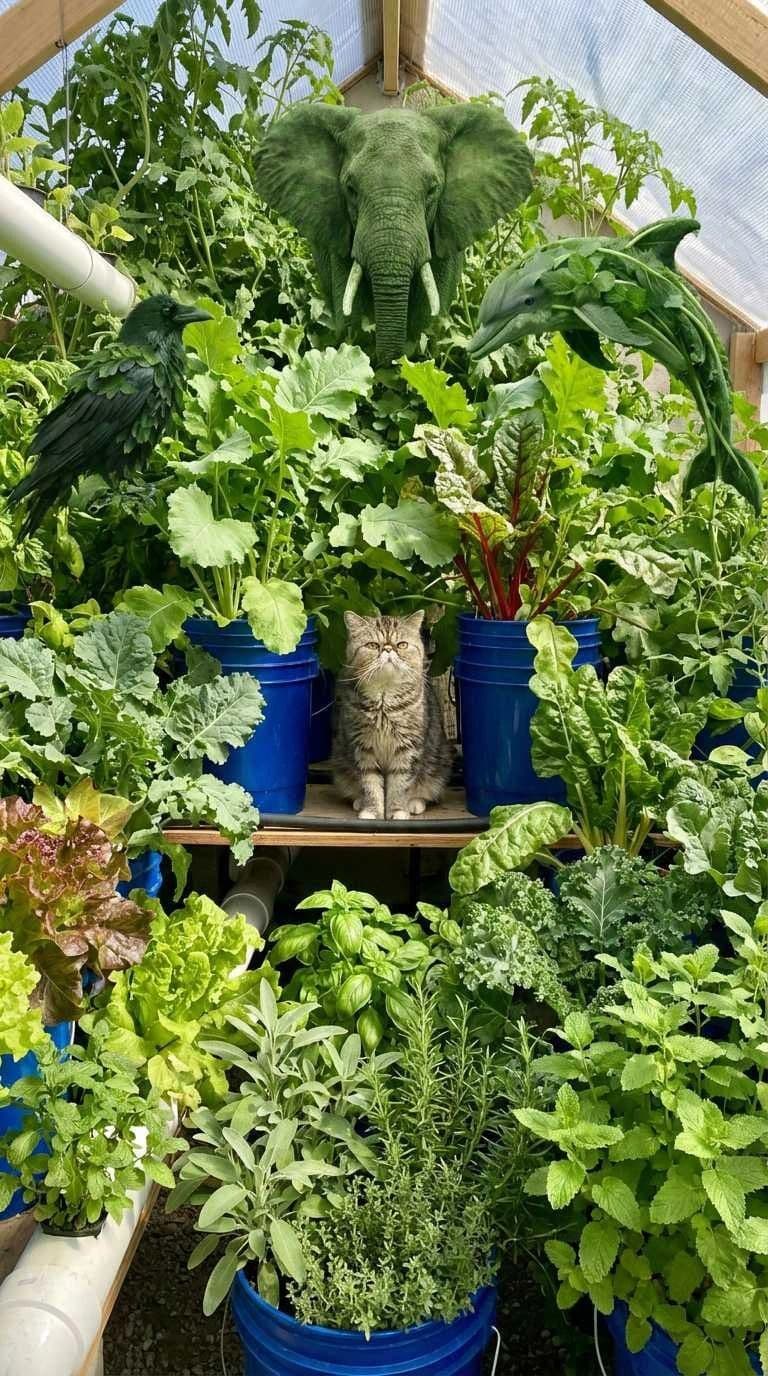
Ellee, from the porch hydroponic garden, watching humans name the world into submission.
The raven tilted his head, locked eyes with me, and croaked a sound I had heard before. My own voice. Not a clean copy. Not a sterile replay. Something slightly off, shaped by a throat that was never designed to flatter human vowels. Intentional.
I froze. The air tightened between us, as if the whole yard had stopped to see whether I would pretend this was nothing.
He had been watching. Studying. Choosing.
He croaked again, sharper this time. A question mark made of feathers. His eyes flicked between mine like he was weighing the outcome of my next move.
My mouth opened. Nothing came out.
Humans love to say animals do not "speak." Humans love even more to say that if an animal makes a human sound, it is not communication. It is a trick. A quirk. A party trick of evolution.
A raven repeats a sound and we call it mimicry. A human repeats a sound and we call it language.
Why?
The First Lie Is Always the Same
The official explanation is familiar: animals do not understand what they are doing. Their sounds are "just echoes." No meaning. No intention. No inner life behind the voice.
That claim always sounds scientific. It is mostly convenient.
Meaning, after all, is not a substance you can hold in your palm and photograph. Meaning is inferred. Granted. Recognized. Meaning is, in practice, a permission slip.
A child learning to talk repeats words long before understanding them. Nobody calls that mimicry. We call it development. We call it potential. We call it a mind arriving.
A human stumbling through a new language borrows sounds imperfectly, misplaces emphasis, repeats phrases they cannot yet explain. Nobody calls that mindless echoing. We call it learning. We call it effort. We call it brave.
The same generosity disappears the moment the speaker is not human.
A raven, a parrot, a dolphin: their vocal intelligence is treated like a novelty that must never be allowed to become a challenge.
The conclusion arrives first. The vocabulary follows.
The Language Trick
Language is not only sound. Language is power.
Power to name. Power to define. Power to categorize. Power to decide which voices count as voices.
If animals can communicate in ways that are meaningful to them, the human story changes. Animals stop being background. They become participants. They become individuals with preferences, warnings, bonds, jokes, grief, memory.
That shift is not harmless to a culture built on using animals.
So the walls go up. Not always with fences. Often with words.
We do it with tiny semantic decisions that seem neutral until you see the pattern:
- A parrot says "hello" and we call it a trick.
- A human says "woof" or "moo" and we call it onomatopoeia, as if we own the right to translate other beings into our language while accusing them of borrowing ours.
- A dolphin uses an individualized signature whistle that appears to function like a name, and humans call it instinct. Our names are identity. Their "names" become biology.
- A bird adopts and reshapes sounds in its environment, and humans call it mimicry. A human absorbs a new dialect and we call it culture.
The sound is not the difference. The speaker is.
The hierarchy is baked into the label. Mimicry is what you call speech when you want to keep the speaker beneath you.
Goalposts on Wheels
Humans have been doing this for centuries, and the pattern is predictable:
First — animals do not feel. When that becomes impossible to deny — animals feel, but they do not think. When thinking becomes obvious — they problem-solve, but they do not have emotion the way we do. When emotion becomes undeniable — they communicate, but it is not language. When communication becomes rich — it is still not "real," because "real" is a word humans reserve for themselves.
The goalposts move because the prize is supremacy.
Research across species continues to complicate the old story. Many animals use vocalizations and signals that vary by context and carry specific information. Some species demonstrate learned communication, social transmission, and long-term memory in ways that do not fit neatly inside "mindless instinct."
Prairie dogs have alarm calls that change depending on the kind of threat. Elephants use low-frequency rumbles that travel long distances, and families appear to coordinate across space in ways humans struggle to perceive without equipment. Corvids recognize faces and can spread social information through groups, building a kind of shared "do not trust that one" memory that lasts beyond the moment. Bats exchange complex vocal sequences, some of which show regional variation that looks a lot like what humans would call dialect.
None of this is presented to claim animals are "little humans." That comparison is another trap. The point is simpler: communication exists on a spectrum. Meaning exists outside of human approval.
Still, we reach for the same minimizing words. Instinct. Noise. Mimicry. Anything that lets us avoid the next step — listening.
They Spoke First
Whales were singing before humans mapped oceans. Their songs carry patterns and traditions that persist and shift over time.
Wolves were calling to one another across distance long before humans claimed "civilization." A howl is not an accident. It is identity and location and relationship broadcast into cold air.
Many birds learn songs socially. Some pass vocal traditions across generations. Some calls function as individual signatures within families and flocks.
Humanity did not invent communication. Humanity industrialized its arrogance about it.
We keep insisting language belongs to us because we wrote definitions that center our own style of speaking: our syntax, our symbols, our tools, our throats. Then we declare anything different to be lesser.
It is an elegant illusion. It keeps the moral terrain tidy.
If animals have meaningful communication, then the world is not quiet. The factory farm is not silent. It is full of voices calling, warning, naming, searching.
The isolated orca is not merely "lonely." That word is too soft. An animal calling for family who will never answer is living inside a grief humans refuse to validate.
The elephant who refuses to leave the place where her mother died is not "just standing there." Stillness can be language too. Memory can be an argument.
These realities are harder to live with than the word "mimicry." That is the point of the word.
The Question We Keep Dodging
The real question is not whether animals have language.
The real question is why humans work so hard to convince themselves they do not.
Once you see that, you start hearing differently. A crow's call is no longer just noise. A dog's whimper stops being "background." A bird's song becomes more than scenery.
The world does not become louder. It becomes less erased.
The silence was never silence. It was a decision.
We just were not listening.