The Bighorn Need This Corridor Open
A 500-kV transmission line threatens to permanently sever the last connected habitat corridor that Peninsular bighorn sheep need to survive — a species already kept alive by emergency helicopter water drops.
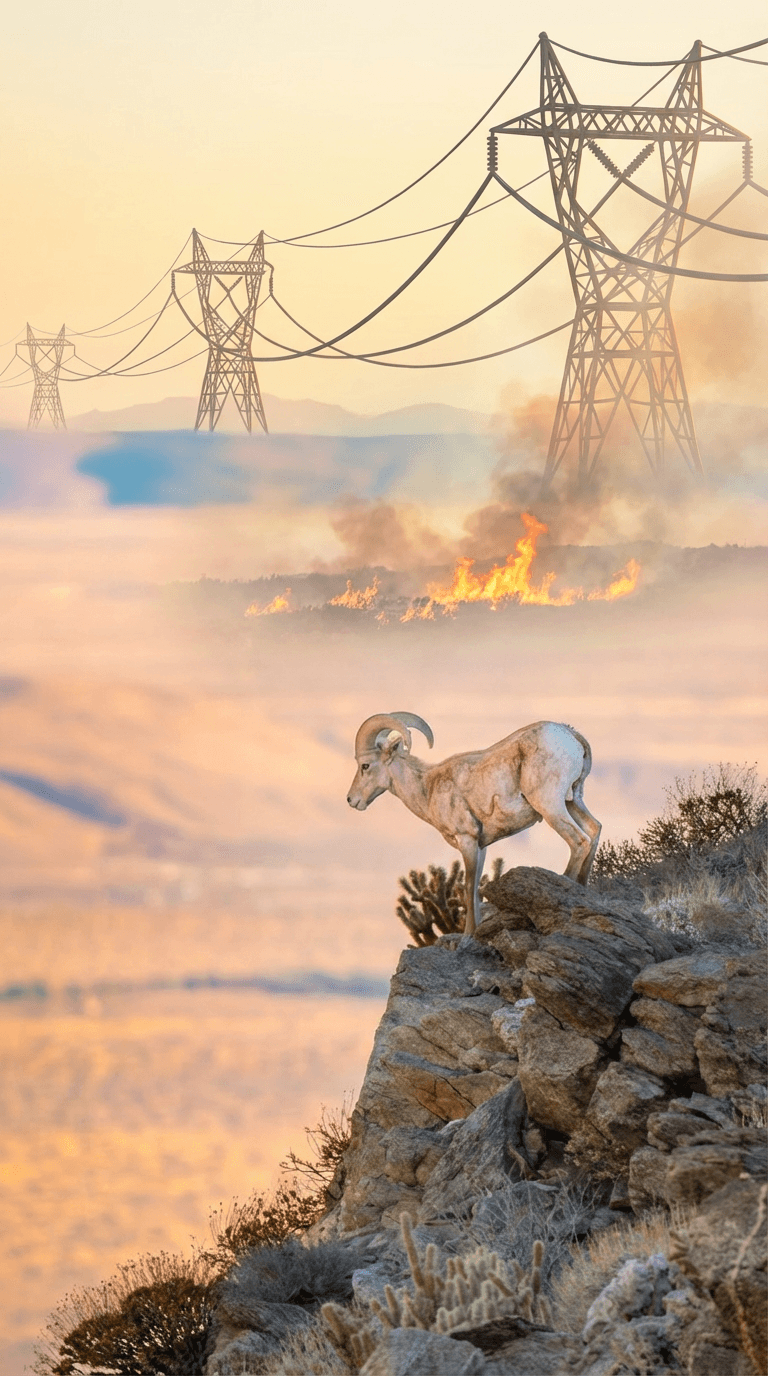
A federally endangered animal already surviving on emergency $500,000 water drops is about to have its last connected habitat cut by a 500,000-volt transmission line.
That’s not a metaphor. That’s a route on a map.
The Peninsular bighorn sheep have been on the U.S. Endangered Species list since 1998. They survive in scattered ewe groups across Anza-Borrego and the Peninsular Ranges, and the federal recovery plan only works if rams can move between those groups to keep the gene pool alive. When the springs dry up — which is happening more often now — Fish & Wildlife flies emergency water in by helicopter to keep them breathing.
SDG&E’s proposed Golden Pacific Powerlink — a 500-kV line with steel lattice towers tall as a 20-story building — would cut a permanent industrial scar straight through the bighorn corridor the federal recovery plan says must stay connected.
This isn’t a partisan fight. Federal biologists across four administrations, conservation hunters who’ve quietly funded bighorn recovery for decades, the Kumeyaay, Cahuilla, and Cupeño nations whose ancestral land this crosses, and ranchers across rural San Diego County are all looking at this map and saying the same thing.
You don’t need a position on California energy policy to agree on this:
An endangered species already on emergency life support shouldn’t have its last connected habitat cut by a 200-foot industrial corridor.
What you can do — 30 seconds to 30 minutes:
⚡️ 30 sec: Share this. People who don’t know this is on the table can’t speak up.
⚡️ 5 min: Sign up for updates at theabf.org/powerline-updates so you know when public comments are due.
⚡️ 30 min: Attend an SDG&E virtual open house May 12 or May 14 (noon or 5:30pm) and put one sentence on the record.
The CPUC rejected this same corridor through this same Park in 2008, calling it environmentally unacceptable with 52 unmitigable impacts. The bighorn were healthier then.
Endangered species shouldn’t be a routing problem. Some places shouldn’t be the cheapest path. This is one of them.
0 notes
Support the Animals
Every dollar goes directly to feed, shelter, and veterinary care for the animals in this story.
Donate Now501(c)(3) · EIN 82-4897930 · 100% tax-deductible